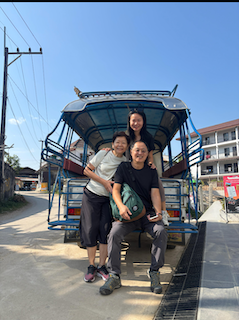
It was a refreshing seven-day break in Laos. I had always been curious about Laos. When my daughter came up with the idea of a vacation for my 70th birthday gift, I was happy it was to Laos. I feel grateful that my children paid for everything: two of them covered the cost of the vacation, and one of them gave me a new Fujifilm camera. These gifts paired beautifully.
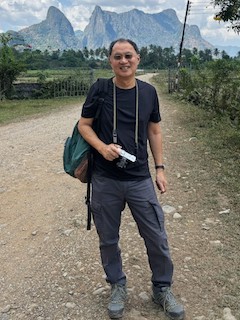
My wife and I were blessed to have Elaine organise and lead with a perfectly balanced itinerary of sightseeing, new experiences, food, and shopping. She was considerate and caring, patient and efficient throughout the visit. Having her with us this way makes up for the many months she has been away working abroad.
At the Changi airport, my soul caught up with my body. I began to feel anticipation and excitement about Laos. Before that, I was absorbed with ministry, recovering from health issues, and other stuff. This was going to be a slow-down vacation. Thankfully, it was not a group tour.
Vang Vieng
Vientiane is the capital, but the beauty was in the north, where the forested mountains and valleys contrasted with the plains of the south. From the airport, we hailed a Loca (their Grab) to the huge rail station built by China, and rode comfortably for an hour up to Vang Vieng.
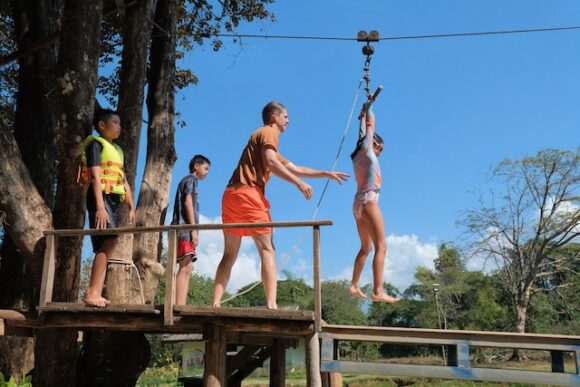
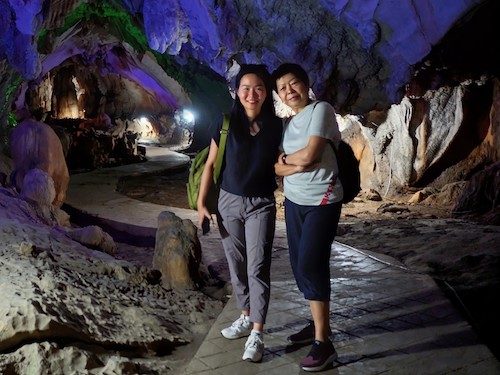
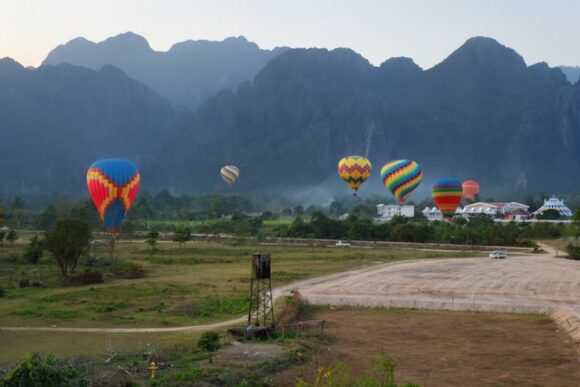
Vang Vieng is known for its blue lagoons and caves. The hotel we stayed in was modern, clean, and lovely. From where we stayed, we had a vista of the limestone mountains and of the hot air balloons and paragliders landing ground. None of us is adventurous, so we were observers more than participants; spectators, rather than players; commentators rather than doers. (In church, by God’s grace, we are the opposite!). The sunsets were spectacular, and the food was affordable and interesting.
Luang Prabang
After two nights, we took the train to Luang Prabang, where we stayed three nights. This time, the hotel was a preserved building situated in the UNESCO World Heritage Old Town. The old town was set between the Mekong and Nam Khan rivers, with the mountains in the background. It has preserved a unique blend of Lao wooden buildings and French colonial-style concrete buildings, thanks to the UNESCO designation and intervention.
There are temples, many cafes and restaurants, hotels and boutique shops. I love the slow-down vibe the whole place gives. Traffic was sedate, the air was tranquil, the lanes were peaceful and quaint. I loved walking the streets in the evening. We never felt worried about safety while walking around during the day in crowded places, in the morning and night markets, nor walking home in the dark of night.
The night market was typical of those found in Thailand. The usual things. The morning market was more interesting, featuring indigenous food products, both raw and cooked. There were also the stalls that sold cookware, hardware, clothing, bags and shoes. I saw some tea from hundred-year-old trees tied with rustic bamboo strips, and this was the only souvenir I bought.
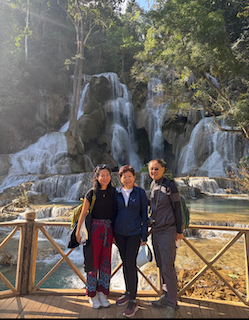
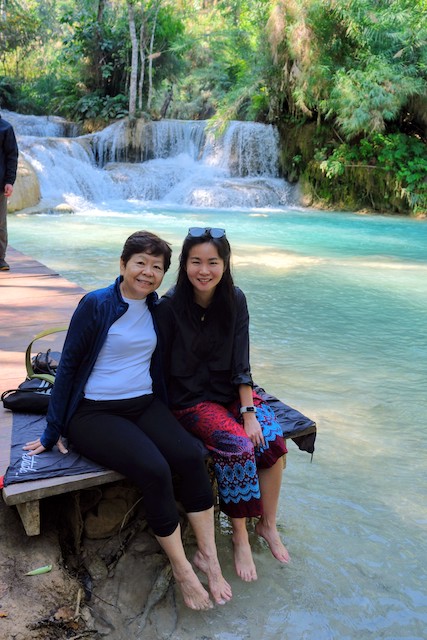
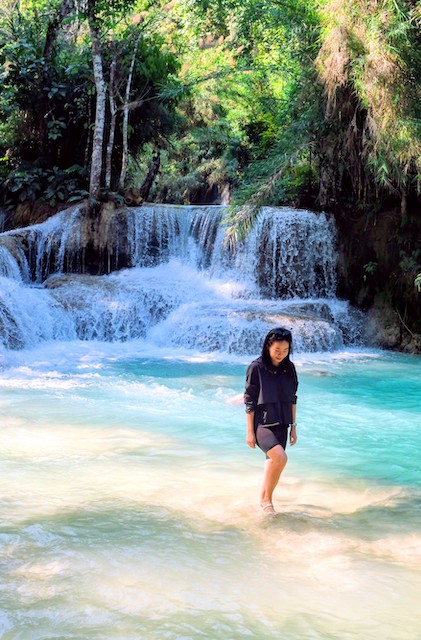
I thoroughly enjoyed the Kuang Si Falls. It reminded me of the walk up the bitumen track of Bukit Timah Hill, albeit with gentler elevation. The waterfall was stunning for its breadth and multi-tiered cascade, rather than spectacular for its ferocity or height. The water is a milky turquoise colour, as it flows down numerous mini-falls into limestone pools. These pools were safe and permissible for people to take a dip in. I enjoyed the walk downhill through lush forest, on a well-trodden trail and wooden platforms past the three main pool areas. Near the entrance and exit, we passed through a bear conservation project.
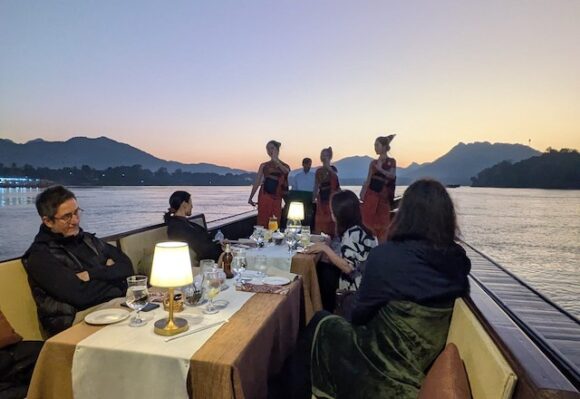
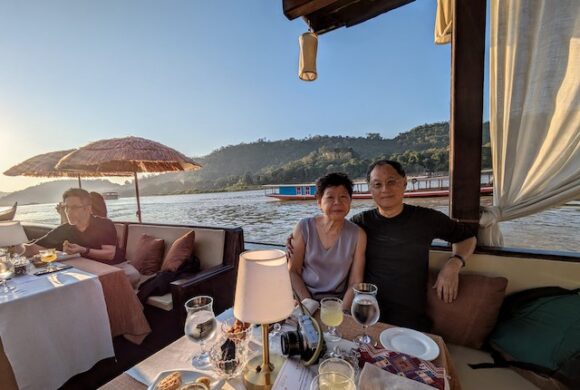
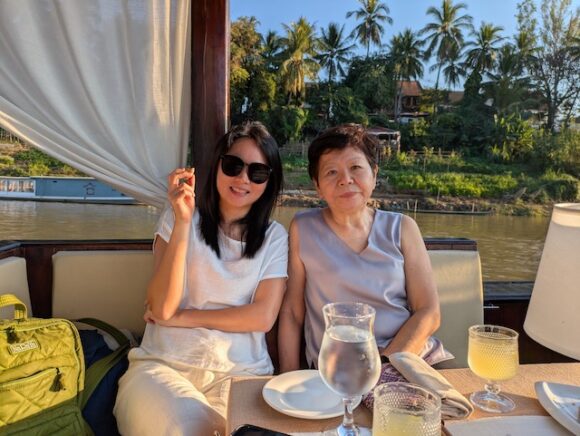
Another highlight was a sunset cruise in a boat along the mighty but calm Mekong River. The ambience was good, and so was the food, music and dance with the sun setting behind the mountains as the backdrop. As the night descended, the temperature dropped, and they offered blankets. The service was impeccable.

I believe the most memorable and instructive of all was the Lao storytelling hour. Two men, one the storyteller who speaks in English with a Lao lilt, and a musician who plays the Lao Khaen, a bamboo wind instrument. He told us tales and legends from Lao folklore about the origins of the Lao kingdom, the Mekong River, prominent mountains, and national figures of ancient Lao. He held the audience of about 30, mostly Caucasian, spellbound, with his expressive face and lilt, interspersed with the soulful, bird-like sound of the bamboo Khaen. When I preach, I must never forget that Jesus connected and engaged his audience with his many stories and parables.
It was a good thing Elaine made a change during our holiday. We meant to stay two nights in Luang Prabang, but she changed it to three nights. While she had to change hotel bookings, it was worthwhile because we enjoyed Luang Prabang the most.
To me, Vientiane is a mere necessary transit point.
As an aside, I passed by one Evangelical Church in Vientiane. A driver told us that most Laotian people are mainly Buddhists. The ban on Christianity has been lifted since the early 2000s, and there are a few churches around (under state supervision), but proselytising is forbidden by law. Thus, the relationship of the government and Christianity is often in flux. A quick check on Google shows an estimated 3% (Catholics and Protestants) out of a total population of 7.9 million.
If you find this content helpful, follow me in my new WhatsApp channel: BLOGPASTOR or my Telegram channel: t.me/blogpastor. It will keep you informed of my latest post. Thank you for your support.
I was in the Laos missions committee and had to travel to Laos on serveral occasions. Our role in the ARDA was handy in the putreach to Laos. Tell you more when we meet.
The Anglican diocese of Singapore has translated its charismatic renewal into a wonderful outreach to S.E. Asia. Yes I will be eager to hear more about the works of God in Laos! Thank you ps Vincent.