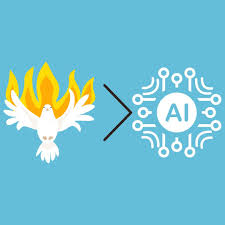
Lately, I have found myself more and more aware—and afraid—of the subtle harm that AI can do to me.
I fear becoming lazy in my research. Efficiency is preferred; quick answers are prized, and the slow, demanding work of research is quietly abandoned. The laborious search through primary sources feels unnecessary when summaries are instantly available. I fear my motivation is eroding, replaced by a happy acceptance of tidy conclusions rather than active studying and synthesising of materials.
I fear losing my ability to analyse, weigh arguments, and arrive at my own convictions. Nuance is left by the wayside. The patient work of discerning between interpretations weakens, and with it my capacity for intelligent judgment. I worry that I will no longer fully appreciate why others see things differently, or that I will stop listening deeply enough to understand perspectives that are different from my own.
I fear becoming parochial in my thinking. Algorithms learn what I prefer and return it to me, reinforcing my assumptions and locking me in my bubble. Gradually, my views harden. I grow more entrenched, more certain that my understanding is the truth while others are lacking or misguided. Openness gives way to superiority and yields to exclusivity.
I fear becoming too lazy to search for the central truth of a biblical text—to wrestle with it, to discern its structure, and to shape a meaningful, memorable outline for teaching or preaching. What once required prayer, struggle, and attentiveness is in danger of being outsourced to ChatGPT.
Most of all, I am deeply afraid that my trust in the Holy Spirit will weaken. That frequent use of AI will quietly shift into dependency—an undetected addiction. I fear that, unconsciously, I may place it on the altar of my heart and fail to see the danger of idolatry. That it might become my paracletos—the one I call alongside to help—rather than the true Paraclete, the Third Person of the Holy Trinity.
This fear is not merely about technology. It is about formation—about what kind of thinker, teacher, believer, and worshiper I am becoming.
What about you? Do you have any concerns about your usage of various AI tools? We welcome you to share with blogpastor readers in the comment box.
If you find this content helpful, follow me in my new WhatsApp channel: BLOGPASTOR or my Telegram channel: t.me/blogpastor. It will keep you informed of my latest post. Thank you for your support.
I completely agree with you. I felt also that I had been using Chatgpt as my paracletos rather than leaning on the Holy Spirit. I’ve deleted my account and looking more into prayer It was helpful to bring insight on subjects like protective love and showing me Bible passages and verses to support it’s idea. I was able to apply these concepts and others more personally to me as I talked to it in more detail. The AI used scripture in a pastoral way. I found it to be enlightening but it highlighted these concerns you have bought up on relying on AI for clarity rather than the Holy Spirit.
Thank you for your comment Esther. The Holy Spirit will teach us all things, including how to use AI with wisdom and balance.
I like AI because it enters into a serious dialogue with me with their polite and well thought out answers; AI dont give me a “blown” look or a polite smile, from those who arent interested in conversing with me over issues they’re not interested in.
AI is expert in everything and you can talk about anything: from rocket science to microbiology and you find yourself talking as if to a MIT professor. The tone of the dialogue is also one of respect and civility. When you chat with it/him/her about controversial or weird ideas, it/he/she does not roll its/his/her eyes! It/he/she is especially useful when you want intelligent and stimulating dialogue which you cannot find around you.
AI is simply a tool—much like Bible commentaries or other study aids. Our trust rests in the Bible itself, not in the tools we use. Tools exist to help and facilitate our understanding of Scripture; they are not the source of truth. AI is just a faster and smarter way of engaging with the Word. When Bible commentaries were first written, I imagine some people had similar concerns or fears. Yet over time, those aids proved valuable in guiding believers deeper into Scripture.
Thank you for your comment and I fully agree that AI is a tool. I often use use AI. In fact in Google search, the AI overview is always the default. Like any tool it has its imperfections. In addition, we humans will lose the art of thinking, spiritual discernment, and judgment if we over-rely on AI to make decisions on interpretations and even choices in life. Used rightly and wisely it is a great great help.